All types of quartz are one mineral, silicon dioxide, at about 7 on the Mohs scale. Crystalline types include clear, milky, amethyst, citrine, smoky and rose quartz. Microcrystalline types include chalcedony, agate, carnelian and jasper.
Every type of quartz you’ll find in a crystal shop, from water-clear points to pink tumbled hearts to banded agate slices, is the same mineral in a different form. That’s what makes quartz such a rewarding family to collect. Once you understand the single mineral underneath, every variety starts to make sense. This article covers the main crystalline and microcrystalline varieties, the collector and trade names you’ll see on labels, how to tell the stones apart, what each one means in crystal traditions, and how to look after them.
What Is Quartz?
Quartz is silicon dioxide (SiO2). Its silicon and oxygen atoms are locked into a continuous three-dimensional framework of tiny four-sided units called tetrahedra, and each oxygen atom is shared between two of them. That tight, interlocking structure explains much of how quartz behaves. It’s also extremely common: quartz is the second most abundant mineral in the Earth’s lithosphere (the crust plus the rigid upper mantle), making up roughly 12% of it by mass. That’s why it turns up in so many rocks, veins and cavities.
Quartz has a hardness of 7 on the Mohs scale, a 1 to 10 ranking of minerals by which one can scratch which. Quartz is one of the reference minerals that define the scale. Impure varieties can rate slightly lower. A few more traits are worth knowing:
- No cleavage. Quartz doesn’t split along flat planes. It breaks with a curved, shell-like surface called a conchoidal fracture, and it’s brittle, so it chips if you knock it.
- Glassy lustre. Well-formed crystals have a vitreous shine. Massive, fine-grained quartz looks waxy or dull.
- Classic shape. A typical crystal is a six-sided prism ending in a six-sided point.
- Piezoelectric. Quartz produces a tiny electrical charge when it’s squeezed, which is why it’s so useful in electronics and timekeeping.
Why there are so many types of quartz
The many types of quartz come from a few simple differences. The first is colour: quartz can be colourless, white, pink, orange, yellow, green, blue, purple, brown or black. The second is crystal size. Macrocrystalline quartz grows crystals big enough to see, while microcrystalline quartz is made of crystals far too small to see, packed into a solid mass. The third is inclusions and growth habits, such as threads, coatings or a crust of tiny crystals. On top of all that, sellers have invented many trade names. Because of this, there’s no official count of quartz types, and anyone who gives you an exact number is counting names rather than minerals.
One quick clarification: quartz worktops and countertops are an engineered, manufactured material. That’s a separate subject from the natural stones covered here.
The Main Types of Quartz at a Glance
This table compares the varieties you’re most likely to meet, sorted by grain. The associations in the last column come from crystal traditions. They are beliefs, not proven effects.
| Variety | Grain | Typical look | Traditional associations |
|---|---|---|---|
| Clear quartz (rock crystal) | Crystalline | Colourless, transparent points and clusters | Clarity, focus, amplifying intention |
| Milky / snow quartz | Crystalline | Cloudy white, translucent to opaque | Peace, gentleness, patience |
| Amethyst | Crystalline | Lilac to deep violet, often in clusters and geodes | Calm, intuition, sobriety in folklore |
| Citrine | Crystalline | Pale yellow to golden orange | Optimism, abundance, confidence |
| Smoky quartz | Crystalline | Grey, brown to nearly black, transparent | Grounding, protection |
| Rose quartz | Crystalline (usually massive) | Soft pink, milky-translucent | Love, compassion, self-kindness |
| Ametrine | Crystalline | Purple and yellow zones in one stone | Balance between calm and energy |
| Chalcedony | Microcrystalline | Waxy, translucent, often white or soft blue | Gentle communication, calm |
| Agate | Microcrystalline | Banded in rings or layers, many colours | Stability, balance |
| Carnelian | Microcrystalline | Translucent orange to red-brown | Courage, motivation, creativity |
| Jasper | Microcrystalline | Opaque, patterned reds, yellows, browns, greens | Endurance, nurturing, steadiness |

Crystalline Types of Quartz and Their Meanings
These are the types of quartz that grow visible crystals. You’ll find them as raw pieces (natural, unpolished), as points (single crystals with an intact tip), as clusters (many crystals growing from a shared base), and as tumbled stones, which are small pieces rolled in a barrel with grit until they’re smooth and rounded.
Clear quartz (rock crystal)
Clear quartz is the colourless, transparent form, and it shows the classic six-sided point at its best. In crystal traditions it’s often called an amplifier, a stone believed to strengthen whatever intention you bring to it. Many people keep a point on their desk as a focus object or hold one during meditation. Because it’s colourless, it’s often paired with other stones. Our clear quartz library entry covers its folklore in depth, and Spirit Magicka has a range of quartz points and clusters if you’d like to see the variety in person. Care tip: the tips chip easily, so stand points upright or wrap them when they aren’t on display.
Milky and snow quartz
Milky quartz is the white, cloudy form. It’s one of the most common types of quartz and is often found as chunky vein material rather than neat crystals. Opaque, snowy pieces are sold as snow quartz. Traditions link it with peace and quiet patience, and many people like it as a soft, undemanding palm stone. It’s sturdy and easy to care for.
Amethyst
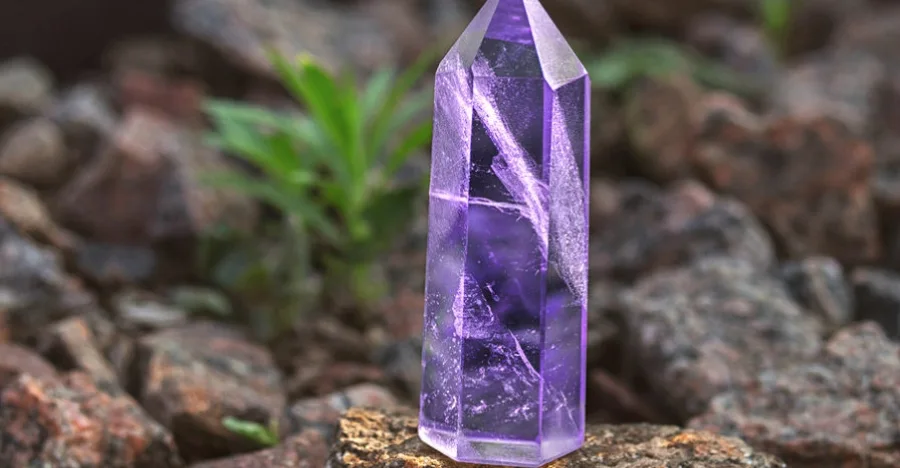
Amethyst is the violet variety, ranging from pale lilac to deep grape. It often grows inside geodes, hollow rock cavities lined with crystals (our article on what a geode is explains how they form). Its name comes from an ancient Greek word meaning “not intoxicated,” and in folklore it was linked with sobriety and a clear head. Today it’s widely used in calming bedtime rituals and is associated with the crown chakra (one of the seven energy centres described in yogic traditions). It’s also the February birthstone. Read more in our amethyst guide. Many collectors keep amethyst out of strong direct sun as a precaution against fading.
Citrine
Citrine ranges from pale lemon to warm golden orange. Crystal traditions call it a sunny stone of optimism and abundance, and some people keep a piece near a cash box or workspace for that reason. It’s associated with the solar plexus chakra and is a November birthstone. Because colour treatments exist in the trade, it’s fair to ask a seller whether a citrine’s colour is natural. You’ll find it with its relatives in our Quartz & family section.
Smoky quartz
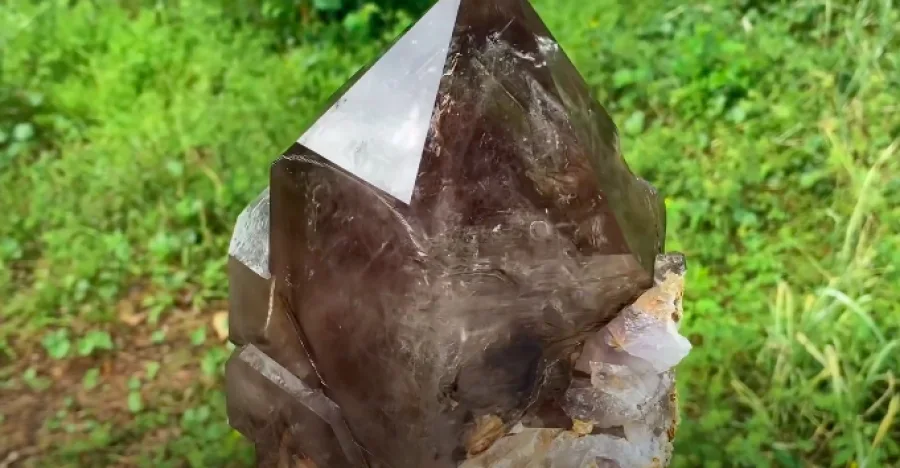
Smoky quartz runs from light grey-brown to almost black, yet it often stays transparent, which gives it a lovely depth in a window. Traditions treat it as a grounding and protective stone, associated with the root chakra. It’s a favourite for placing near a front door or holding at the end of a busy day. It appears on our list of crystals for protection, and the smoky quartz library entry goes further. Spirit Magicka stocks smoky quartz in several forms.
Rose quartz
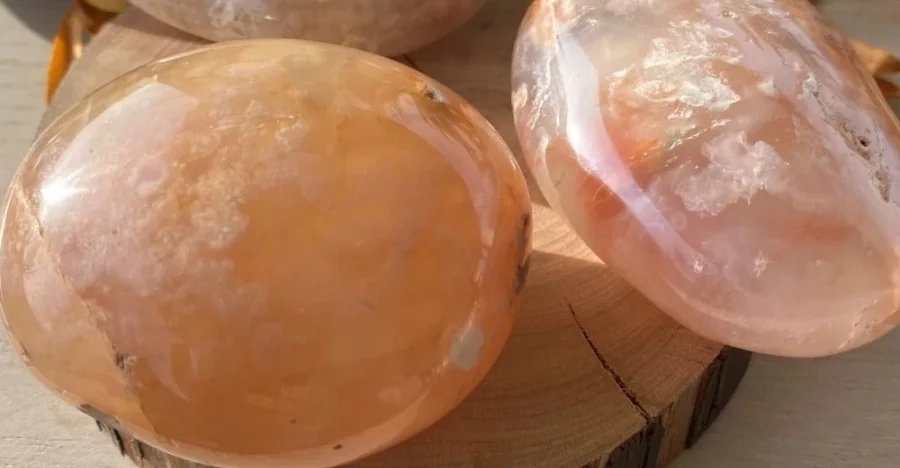
Rose quartz is the soft pink variety. Most pieces you’ll see are tumbled, carved or cut from massive material rather than sharp crystals, and they have a gentle milky glow. It’s probably the best-known love stone in crystal traditions, linked with compassion, self-kindness and the heart chakra. People carry it, wear it as jewelry, or place it in a bedroom. Our rose quartz meaning article covers its lore, and you can browse rose quartz at Spirit Magicka. Treat its colour like amethyst’s and keep it out of harsh sun.
Ametrine
Ametrine combines amethyst purple and citrine yellow in a single stone, often in distinct zones. Traditions read that pairing as balance: the calm of amethyst alongside the brightness of citrine. Cut stones show the colour split beautifully in jewelry. See our ametrine guide.

Microcrystalline Quartz: Chalcedony, Agate, Carnelian and Jasper
The other branch of the family is made of quartz crystals too small to see without magnification, packed into solid masses. These stones never form pointed crystals. Instead they look smooth, with a waxy rather than glassy shine, and impure pieces can be a little softer than crystalline quartz. They’re ideal for tumbled stones, cabochons (smooth domed jewelry stones), beads and carvings.
- Chalcedony is the general name for the translucent, waxy members of this group. Plain pieces are often white, grey or a soft blue. Traditions link it with gentle communication and calm.
- Agate is chalcedony with bands, which can be concentric rings, straight layers or lacy patterns, in almost any colour. It’s linked with stability and balance. See our agate meaning entry.
- Carnelian is translucent orange to red-brown chalcedony that seems to glow when you hold it up to light. Traditions call it a stone of courage and motivation, associated with the sacral chakra.
- Jasper is opaque, often heavily patterned, and comes in reds, yellows, browns and greens. It’s associated with endurance and steadiness, and many people find it a comforting worry stone.
Tiger’s eye, with its silky golden bands, is often shelved alongside the quartz family in collections too. Our tiger’s eye guide covers it separately.
Collector and Trade Names: Spirit, Cactus, Faden and More
Many quartz names describe a growth habit, an inclusion or a treatment rather than a new mineral. Knowing which kind of name you’re looking at saves a lot of confusion.
- Spirit quartz and cactus quartz are crystals covered in a drusy coat, a crust of tiny sparkling crystals over a larger one. Traditions associate spirit quartz with harmony and community. See spirit quartz and cactus quartz.
- Faden quartz takes its name from the German word for “thread.” Collectors use it for crystals with a fine white line running through them. Read the faden quartz entry.
- Blue quartz is a name for quartz with a bluish tone. Our blue quartz page explains how the name is used.
- Cherry, mystic, moldau and silver quartz are names whose meaning depends on the seller. Some describe natural stones, while others describe treated, coated or manufactured material. Before buying, ask what the piece actually is. Our library pages for cherry quartz, mystic quartz, moldau quartz and silver quartz cover the traditions attached to each name.
How to Tell Types of Quartz Apart
You don’t need lab equipment to sort most types of quartz. Work through these checks in order:
- Look at transparency. Hold the stone up to a window. Transparent or glassy points suggest crystalline quartz, while a soft glow or full opacity points toward the microcrystalline group.
- Check the lustre. Glassy and bright usually means crystalline. Waxy or satiny usually means chalcedony, agate or carnelian. Jasper is often duller still.
- Look for shape. A six-sided prism ending in a point is classic crystalline quartz. Microcrystalline varieties never show it.
- Look for pattern. Neat bands suggest agate. Busy, opaque patterns suggest jasper. Purple and yellow zones in one stone suggest ametrine.
- Ask about treatment. Unusually vivid or perfectly even colour is worth a question. Good sellers will tell you whether a stone is natural, heated, dyed or coated.
A worked example
Picture a tray at a crystal fair holding three warm-coloured tumbled stones. The first is pale pink and milky, and light passes softly through it: that’s rose quartz. The second is orange and glows like a coal when you tilt it toward the light, with a waxy surface: that’s carnelian. The third is brick red, completely opaque and speckled: that’s red jasper. All three are quartz, but they belong to different branches of the family, and lustre and transparency tell you which in a few seconds. If a fourth stone labelled “cherry quartz” sits nearby with flawless, uniform colour, that’s the moment to ask what it’s made of.

How to Care for Quartz Crystals
Quartz is one of the easier crystal families to look after, but hard isn’t the same as unbreakable.
- Store pieces separately. At hardness 7, quartz can scratch softer stones, and because it’s brittle, points and cluster tips chip when they knock together. Wrap points in cloth or use a lined drawer.
- Clean gently. Quartz doesn’t dissolve in water under ordinary conditions, so solid crystalline and tumbled pieces can be rinsed in lukewarm water, brushed softly and dried well. Avoid soaking clusters on a rock base, glued pieces, dyed or coated stones, or anything porous. Skip harsh chemicals.
- Watch the sun. Many collectors keep amethyst, citrine, rose and smoky quartz out of strong direct sunlight as a precaution against fading. A clear quartz sphere on a sunny windowsill can also focus light like a magnifying glass, so keep it away from fabrics and paper.
- Choose cleansing rituals with care. Moonlight, sound and visualisation are gentle on every type. If you use smoke, ventilate the room and keep it away from pets and children. Our guide on how to cleanse crystals compares the methods.
- Don’t drink from your crystals. We don’t recommend putting any stone directly into drinking water, because dyes, coatings, a host rock or a look-alike may not match what the label says.
- Keep small stones away from little ones. Tumbled stones are a choking hazard for young children and pets.

Common Mistakes When Collecting Quartz
- Treating every name as a separate mineral. A dozen labels can all describe the same silicon dioxide. Learn the two main branches first and the names fall into place.
- Assuming all colour is natural. Treatments and coatings are common in the trade. They aren’t wrong, but you deserve to know about them.
- Scratch-testing stones you love. Hardness tests leave permanent marks. Lustre, transparency and shape will usually tell you enough.
- Missing damage. Check the tips of points and clusters before buying. A chipped tip changes both the look and the value.
- Expecting proof. The meanings in this article are traditions people find meaningful, not scientific claims. Our editorial approach explains how we write about them.
If you’re just starting out, a tumbled clear quartz, rose quartz and smoky quartz make an easy first trio. They’re durable and easy to tell apart, and between them they cover clarity, love and grounding. From there, you can explore the rest of the family in our crystal library or browse the wider range at Spirit Magicka. Once you know what you’re looking at, the different types of quartz become one connected family.
Questions
How many different types of quartz are there?
There is no single official count. Mineralogically, quartz is one mineral, silicon dioxide. The varieties come from differences in colour, crystal size, inclusions and growth habit, and the trade adds many more names. Most guides list about a dozen major types: rock crystal, milky, amethyst, citrine, smoky, rose and ametrine on the crystalline side, plus chalcedony, agate, carnelian and jasper on the microcrystalline side. Collector and trade names push the list much higher.
What is the hardness of quartz on the Mohs scale?
Quartz is 7 on the Mohs scale, which ranks minerals from 1 (softest) to 10 (hardest) by which one can scratch which. Quartz is actually one of the reference minerals that define the scale. Impure and microcrystalline varieties such as some jaspers can be a little lower. A hardness of 7 means quartz holds up well to everyday wear, but it is still brittle, so a knock can chip it.
What does vinegar do to quartz?
Quartz itself does not dissolve in water or in household-strength vinegar under ordinary conditions, so it won't be eaten away. Vinegar can still damage other things that come with a quartz piece, though: a matrix rock, glue, dyes, surface coatings, or a stone that only looks like quartz. If you aren't sure what you have, skip acidic cleaners and use lukewarm water and a soft brush.
How much is 1 kg of quartz worth?
There is no single price, because the value depends almost entirely on the type and quality. Rough, common material is inexpensive by weight, while transparent, well-formed crystals, rich colour, undamaged points, attractive clusters and unusual inclusions are priced as individual specimens rather than by the kilo. When comparing offers, look at clarity, colour, damage and whether the stone has been treated before looking at the weight.
Which type of quartz is best for beginners?
Clear quartz, rose quartz and smoky quartz make an easy starting trio. They are widely available, hard enough for everyday handling, simple to identify, and they cover the themes crystal traditions associate with quartz most often: clarity, love and grounding. A tumbled stone of each costs little and lets you get to know the family before buying clusters or rarer varieties.
Stay curious. Stay connected.
Read our editorial approach